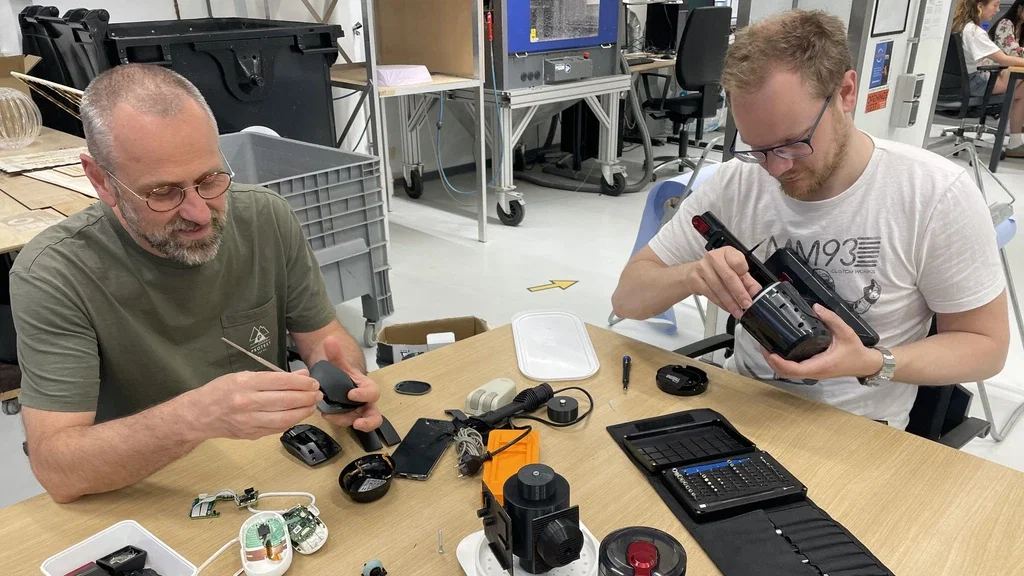
The products covered by the obligation to repair currently include:
- washing machines and washer-dryers
- dishwashers
- refrigerators
- electronic displays
- welding equipment
- servers and data storage products
- mobile phones, cordless phones and tablets
- tumble dryers
- e-bikes and e-scooters batteries (from 18 February 2027)
- local space heaters
They pass dystopian chat control with one hand and does this with the other.
The EU is a complex organization with different power poles and a variety of different interests. Add to that members of parliament do not always understand everything they vote for. And yes: you get bad things, nonsensical rules, but also good things.
Overall, I would say it’s positive, but when it’s bad it can be brutal.
Edit: I forgot to mention lobbying! Brussels is full of lobbyists!
All those people in Brussels are out of touch. They live in their own world.
Well when you think about it this is just another form of control over businesses. That’s equally authoritarian.
If businesses were people that’d be a great point.
There is no repair without firmware. All hardware needs to be documented and ship with source. It hasn’t been enough to be able to buy physical parts since perhaps the 80s or 90s. Everything is controlled by software. Without that right to repair is a joke. Meanwhile the surveillance industry and their well greased govt supporters are trying to lock down software. Can’t have it both ways.
Interesting things that are not on the list:
- Farming equipment
- Motor and electric vehicles
- Computers (including laptops)
- Video game consoles
- HVAC systems and equipment
Not sure if smart TVs fall under “electronic displays”, or if they just mean commercial displays when they say that.
Computers are not on it because you will never own one in the future. You will lease them.
What exactly do you think you’d be able to easily repair on a video game console?
Broken ports, replace hard drive, replace memory, no software locks so custom software can keep it alive, replace battery (on a Switch for example).
Lots of thing right to repair could do for consoles.
Video consoles are either desktop computers with proprietary parts, or tablets with proprietary parts. There is nothing especially difficult to repair in them compared to the rest of their categories.
Water kettle stopped working, has fucking temper proof triangle head screws so can’t even open it without having to buy a special screwdriver bit. name and shame : kitchenaid
Most of the time it’s not about repairability it’s about mitigation of responsibility. If they make it difficult to get into and you do it anyway then burn your house down because you removed the thermistor they have a better case in court.
I can go one further, if you ever want to do a warrenty claim with coffeemate, regardless of how small, they require you to cut the power cord.
I bought a cheap coffeemate coffee maker, and the anti-splash valve that prevents it from brewing fell off, and I lost the o-ring that was part of it as a result.
After 3 different contact points with coffee mate as their public listed email only warranty contact was incorrect and then was bounced to a couple more emails, they agreed it was a manufacturer problem, and that it was covered, but they wanted me to cut the power cord and show proof that the unit was no longer functional, because instead of sending me a 10¢ if that o ring, they wanted me to destroy a other than that one comp a perfectly functional unit, so they could send a whole new unit in it’s place.
I bought a cheap oring set on amazon, so now I have more than I would ever need of orings but, at least it’s less wasteful.
Hold on, don’t they know a cut cord can be soldered back together? You don’t even need image generators to fake breaking it…
They don’t care if you do that, because if you do that they’re in no way responsible for it anymore. If you do that and it burns your house down it’s all on you.
That’s the thing about repairing things at home or anywhere else. You need tools to do so and more than just a screwdriver and a pair of pliers. You often special tools. You can get a set of triangle bits for maybe 4 to 5 euros and you will have them for life. So don’t be a cheap. Either fix that kettle yourself, pay someone with the skills and tools to fix it, or buy a new one. But don’t whinge about not having tools.
And let’s also be honest. Some things need to be tamper proof. Most of you ain’t smart enough and experienced enough to play with things that can injure/kill you or others, no matter how many youtube videos you watch.
A eater kettle does not have that much stuff inside that it should be tamlre proof for fuck’s sake. It can use normal screws like phillips, hex or torx.
if its an electric kettle, I have to disagree. Those have the equivalent of a stovetop going through them when in use, and have a degree of water protection required. I heavily disagree with easy to access and remove screws on those. I still think they should be consumer repairable but, I think buying a set of P screwdrivers or whatever style they choose is a more than secure enough method of protecting people who don’t realize what they are doing.
Being said, many things that do have tamper or non-standard screws I think shouldn’t like the iphones, but I think appliances that have a burner element or a higher power draw should remain one of them.
Phones absolutely should have screws like they have though, as flathead and philips head, especially at that size, are way too prone to burring.
They’re not even really “non standard” screws at this point. Anyone can buy a screwdriver set for a few bucks to disassemble an iPhone.
Yeah but if you’re opening high power stuff while it’s plugged in thats on you. I get tamper protection on power supplies and stuff where you could get shocked by a capacitor. But a big heater not plugged in is harmless
Even if it’s unplugged first, I strongly disagree with the insinuation that since it’s unplugged it’s harmless. This is a device that uses the same amount of power draw as a stove top and has water contact as part of it’s daily use. If someone who doesn’t know what they’re doing decides they want to access it, and does it incorrectly, it has the capability of burning your house down.
Having a standard screw on it like a Phillips or a regular screwdriver significantly lowers the barrier of entry in allowing someone who doesn’t know what they’re doing to work on the equipment, which is why I think it’s fair that a component that has that capability has a something like a hex or a p bit. Those are both something that are not hard to obtain, but also something that you likely won’t find just randomly laying around in your house unless you already regularly work on devices or equipment.
Maybe electric kettles are different where you live, but they are extremely dangerous because of the amount of power needed to heat water to 100% quickly. Iirc some countries don’t even have them because their house can’t provide enough power.
But unless you understand the electrical components and the rules and codes in their use for consumer safety, maybe, just maybe, it should be a little bit difficult to gain access to if your 10 years old.
Go buy some bloody tools and quit your whinging.
Yeah sure I’m gonna buy stupid triangle screwdrivers so my nonexistent 10yo cannot open the heater.
If the said 10yo knows where the tools are it does not matter what kind of screws there are. It just makes me have to buy stupid tools I will only ever use for one appliance.
If it bothers you, buy a thread gauge and replace the triangle head with something you like better.
can we have this in America? Answer: No! in fact in America everything popular in other countries is banned unless it’s used in federal buildings because “security concerns”. yeah… sure… so very worried about “national security” that security risks can only be used in government buildings and not in private homes… yeah sure… that’s secure.
deleted by creator
But not games…
Ah fuck boys, we enacted this landmark repairability legislation for daily use machines, but forgot to include video games.
For real though do you mean game consoles, the software?
They’re referencing the stop killing games initiative that was turned down recently. It is akin to this but the software version.
Unfortunately there are some exemptions. Flexible / folding displays are not covered. Fitness trackers and watches are not covered.
There is also a battery regulation coming in next year to require phone batteries to be replaceable with no tools but that has loop holes too - long life batteries aren’t covered, IP67 rated phones aren’t covered. So you can bet your boots those two reasons will be what makers use to bullshit their way out of it.
Those aren’t loopholes though, they’re part of the legislation. Phone makers don’t need to “bullshit” their way out of anything if they meet the criteria, which almost every mobile phone released these days does - making the regulation pretty pointless lol
Also software… I would love to have regulations that make it clear that the root of trust on all devices need to start by the owner of the device, not by the vendor… That would allow the end users to repair the software on their devices… Replacing it with whatever else they want. Next would be to provide hardware documentation to the owners to program their own devices… I don’t expect that to happen, but I can dream.
The root of trust can never be on the owner of the device for anything that requires actual security.
Fitness trackers would be hard to make them easy repairable, when most of them is waterproof
Gaskets are a thing. Many, many, many watches would brag about their water resistance up to 10, 50, 100 meters depth. So I don’t think the excuse is credible.
Flexible / folding displays are not covered
So that’s why after almost a decade, only now Apple is ready to launch their foldable
It’s a good start.
Pisses me off that laws are required for this, but that’s what we get for being ruled by the Epstein Class.

I’m noticing cars are not part of the list, despite being smartphones on wheels
Presumably the germans must have lobbied tooth and nails against this.
Started as a good idea to regulate industry for the benefit of consumers. Ends up with so many paid-for loopholes it’s mostly useless.
The cynic in me thinks the only reason the law was created from the start was to extort money from big companies.
This law still has a lot of good things in it. Calling it useless is what those companies would want you to do.
Also, more and more products will let you know until when they guarantee production of spare parts (it’s also driven by regulation of course).
For things like these I love Europe. For things like Chat Control I hate Europe
Hopefully this will benefit other countries indirectly, instead of designing one repairable phone and one not repairable, should be easier to just design one.
“Hold my beer” - Nintendo, releasing an EU centric revision. Meanwhile Apple and Samsung are digging up every legal loophole to prevent the law applying to their devices.
iPhones are already super easy to repair. Apple have been at the forefront of this for years.
For the downvoters who are too blinded by their hate for Apple to believe facts:
https://www.ifixit.com/repairability/smartphone-repairability-scores
PROS
- Display and battery repairs are well-prioritized, though not as well as in other (dual-entry) iPhone models.
- Torx screws secure the battery assembly in place, making replacements straightforward.
- Repair parts and instructions are available straight from Apple.
CONS
- Five different screwhead types and the continued reliance on adhesives complicate basic repairs.
the same apple that locks individual parts of devices to user accounts so that they can’t be used for repair?
Same Apple. Signing new parts to your device is incredibly simple and DIY now.
https://www.ifixit.com/repairability/smartphone-repairability-scores
PROS
- Display and battery repairs are well-prioritized, though not as well as in other (dual-entry) iPhone models.
- Torx screws secure the battery assembly in place, making replacements straightforward.
- Repair parts and instructions are available straight from Apple.
CONS
- Five different screwhead types and the continued reliance on adhesives complicate basic repairs.
…but only if you buy the parts new.
I wouldn’t want to be putting second hand parts in my phone when repairing it. I can’t imagine there are many second hand screens or batteries around for sale given they’re the things that are replaced the most.
Not that I’d ever want a second hand screen or battery anyway.
i’m perfectly fine with buying third-party components.
Are we talking about the same apple that invented a new type of screw to keep people from taking their phones apart? The same apple that once people could get a trilobe driver, then made it so that generic replacement screens would not work because of some protection from non-apple hardware? Then went on to make sure that you can’t use non-apple parts in a laptop?
I have to admit that I haven’t checked ifix scores for a hot minute and am surprised that since the iphone 15 Apple consistently beats all other big brands in reparability score. Before that of course they were bad, which is probably why people remember them that way. I like that trend, hopefully Samsung and Google also hop on that bandwaggon any time soon.
Strange that 73 other people, 30+ of who downvoted long after I added the proof, think that ifixit are wrong.
I don’t think they have a problem with the ifixit scores, more with the words you have chosen to convey your message. Also of course you will not find any love for Big Tech in the Fediverse ;-)
My words were the truth, I guess that’s why they have an issue with them 🤣
Great in theory until companies start charging 80% of the product price for a single spare part so you’d rather buy a new product than try to repair your existing one.
This is also mentioned in the directive, and directives are legislative texts. The price may not be set so high as to deter repair.
In practice how does that work?
Let’s say they have replacement phone batteries that cost them $20 to make, does the EU limit their profit margins? Do they investigate to make sure it isn’t excessive? If the company tries to sell it for $50, is that too much?