- cross-posted to:
- hackernews@lemmy.bestiver.se
- cross-posted to:
- hackernews@lemmy.bestiver.se
You must log in or register to comment.
Assuming a checker tool is public it’s enough for a teacher to verify classwork, but AI providers having the sole ability to identify generated content with no way to independently verify is not a real solution.
Plus this site advertises a tool to remove this watermarking, so it can’t be that hard to scrub out if you’re aware of it.
The goal is to ensure that they don’t inbreed their models, not fix the problems they’ve caused.
This won’t fix the inbreeding issue, anyway. The bias is extremely slight, but random, and orthogonal to Claude’s own “slop patterns” and tendencies. And theres tons of other LLM content that will end up in their dataset outside their control.
Besides, as much as Claude accusess others of it, everyone’s training on everyone else’s output and they know it.
I wonder what would happen if some start to watermark document they doesn’t want in Claude training
There’s a key involved that we don’t have, so people can’t do this on their own. It’s pretty fascinating. Training models would have to be told to check for watermarks and ignore them, but yeah that would be an effective way for the providers to avoid ingesting their own AI output.
I’m not convinced that they even know 100% how Anthropic is doing it. I can think of an easier way that doesn’t corrupt the text: just find a bunch of tokens where there is a good spread of token possibilities, and the more often the most likely one is chosen, the more likely it’s AI.
That being said, it doesn’t seem much different from what any of us do to identify AI text — it has lots of tells anyway.
That’s how AI testers work and its why they don’t. Most forms of formal writing are predictable by design. If the AI can predict predictable formulaic writing, it doesn’t mean its AI, its probably just any form of professional writing other than fiction.
Famous public domain works will always be considered AI by those tests, because of course your LLM knows the american national constitution. It was in the training data, so it can predict it with 100% accuracy, therefore your test wrongly calls it AI.
Testing for AI writing that way does not work.
The difference between what you describe and what I describe, is that a 100% match isn’t a hit. Nor is a 90/7/2/1. You need something with meaningful variability. Even within formal papers there are places where word choice is arbitrary as the article explains.
Of course, you’re lacking the context of the full prompt and just feeding in the raw text. Again it gets way more reliable the more text you have.
But it’s moot because the more text you have the more tells will sneak in and you probably don’t even need an AI checker. Those phrases that AI loves but humans use comparatively rarely. It’s not a tell — it’s the whole game!
I thought declaude would be like degoogle.
Nope, turns out what they do is precisely the opposite. They try to remove those described markers. Real scummy.
I’m against trying to “censor” LLMs, but yeah. What’s even the ostensible benevolent scenario for stripping invisible watermarking from Claude?
I can’t think of one, playing devil’s advocate.
It’s pretty scummy, indeed.
I am against AI and LLMs but the reason is quite simple, a lot of modern writing is offical bullshit to get stuff approved. Research grants, medical therapy approval, offical work mail that has to sound professional, job applications (insofar that noone cares what you write, they want a standard template and pick a candidate along qualifications anyways.). All these texts cost a lot of time and it makes no difference if a human or some copy machine writes it. And tbh. were it not for all the disadvantages of modern LLMs i would use it for the exact same reason, because sitting at a grant application for two hours while others do it in 5min is fucking useless and exhausting.
If it’s stuff that no one cares what you write, then they also won’t care if it’s proveably written by AI or not. So removing the watermark still does nothing beneficial.
Okay.
I don’t agree. But let’s say I agree.
…Just don’t use Claude?
Use an LLM without a watermark; there are hundreds to pick from.
In other words, if one is going to try to hide automated writing, I think there should be a bare minimum effort to do so. That includes:
-
Reading/checking the text, to see if it makes any sense.
-
Actually trying to pass it as human.
90% of slop is brain melting slop because this minimum bar isn’t even met. And all Claude’s watermark would do is catch that bottom of the barrel; it wouldn’t censor anyone.
From what I understood you need statistical tests to detect the watermark. You cannot easily detect by eyeballing that a coin will land on heads 55% of the time instead of 50%
-
Ah, that explains why the article smells like an LLM wrote it.
I think the thing that frustrates me most about AI is that so many people seem to have forgotten that writers exist and wrote huge amounts of text - books, news articles, magazines - for centuries. But now, anytime someone writes a few cogent paragraphs, you get people screaming “AI!!! IT’S AI!!!”.
I know, because it has happened to me.
The article, to me, sounds like a competent author wrote it. Which is representative of a lot of the text LLMs were trained on.
I can’t tell you about the text, but the whole site is vibe coded. The CSS, the js, everything. Which doesn’t really inspire much confidence on the text, especially as it’s explaining how to bypass the claude detector.
Well shit, that was fuckin’ interesting.
Yes, AI is evil. So is facebook. But the engineering is still interesting.
That’s one of the things that frustrates me most about this whole AI thing. I fucking hate it and I want it to die, I wish it were never created in the first place. But from a tech enthusiast and a maths nerd point of view, it is super interesting.
Like the performance of these models is shit compared to a real person doing actual work. But if we think about what we are doing on a basic level, the performance is way beyond what I would expect it to be. I wouldn’t expect it to be able to form a coherent sentence or scale as well as it does (even though the resources required to run these is still very high).
It could have been really cool shit people did studies on and played around with to explore the math. Cool little play models we could let go on a bunch of data and see what it did and how. Something for a small group of nerds and experts who are into that kind of thing, for the sake of learning and nothing else.
But no, somehow it got transmorphed into “AI”. And marketed like this actual learning almost sentient computer system that can replace all workers. You can ask it anything and it will give PhD level expert answers. Oh and it’s run by a handful of the most vile men imaginable who pour all of the world’s money and resources into it, all so they get to be god emperor of the world. Fucking terrible.
AI isn’t evil. Generative AI isn’t evil. AI has existed for 20+ years now, I studied it back in my uni days.
Corporations, how they trained it, how they use it now, how they are willing to pave the planet to force it down our throats is evil.
This is one of those things as tech people we have to come to terms with and understand. No technology is inherently good or evil, it’s what people do with it.
That’s a weird way to agree, but ok.
I’m not saying binary computing is the tool of the devil. Well, maybe Windows.
Well, yes. You just said AI is evil because capitalism made it evil.
Interesting stuff. My own far less scientific reading of the article itself seems to fittingly suggest it too is largely if not entirely AI generated, which I guess would make sense.
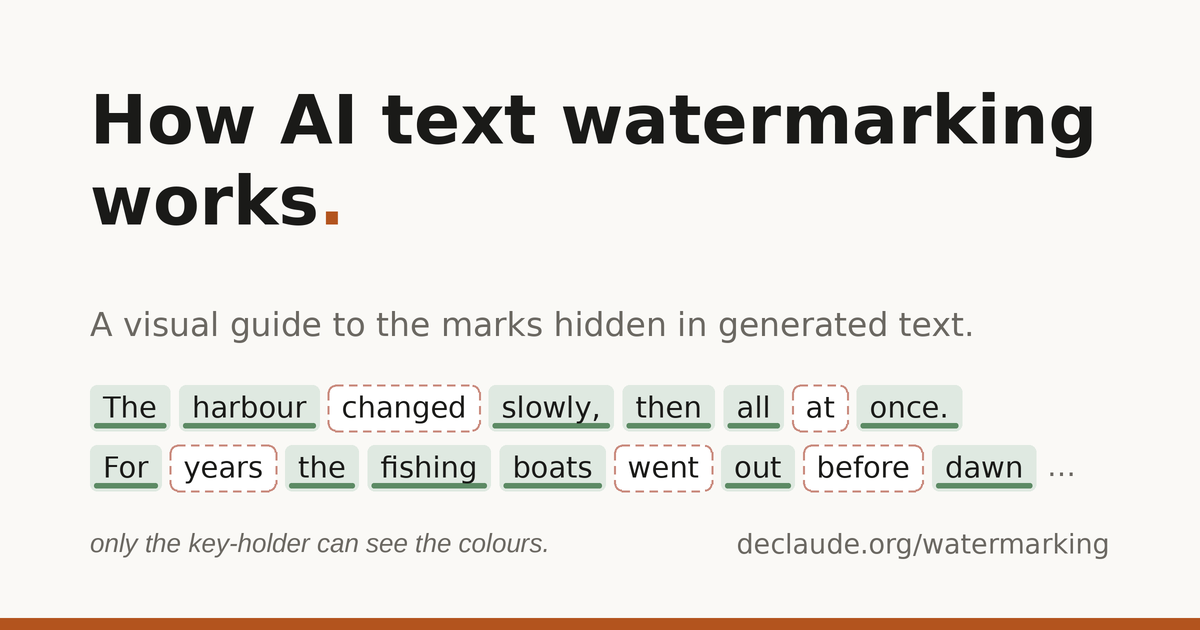
- Only the key-holder can check. Your teacher, editor, or favourite “AI detector” website cannot run this test; a genuine check needs the provider’s secret key, or a checking service the provider runs. Google runs an early-access detector portal for SynthID; Anthropic says detection tooling is forthcoming.
I am not so sure about that. The amounts of words is finite and with enough text, you will see that certain words are used more often, especially in certain combinations. I believe people will brute force this and then create a way to destroy the watermark again.
Yeah, they can’t easily rotate keys, because the text can’t tell you which key was used.
They could switch to a new key e.g. every month and then just check every previous key during detection. But that would slowly increase the likelihood of false positives, so no idea if that’s a good idea either.
Unless I missed something, that seems pretty brittle. Wouldn’t any minor editing break it because the watermark is derived from the preceding text? Eg. Find + replace “it is” to “it’s”
Yes you missed at least one whole section including a graphic that shows the breakdown of the watermark with typo fixing, light paraphrasing, moderate and heavy editing.
But it doesn’t work. It looks like only the owner of the text generator is able to check if some text is written with this concrete generator (with some probability). I see no use of this technique.
It works for them not scraping their own slop back into training data. I assume that is actually the real purpose of the system. They don’t want to share the key with the public. But they probably will with other llm companies in exchange for theirs.
Hmm, yes. I just thought about outside usage, somehow haven’t thought about it as an inner LLM maintenance tool.
The article seemed to claim that some models allow outsiders to submit text for detection if I read it right. That seems like a decent way of doing it. If you “open source” the raw data, it means people can do things to try and get around it - same reason most websites don’t reveal their anti-spam techniques.
That’s still not very useful unless the test is for all AI models otherwise you have to manually submit the text to every AI companies detection system.
I see an opportunity for an AI test aggregator company that checks all of them for you at once.
Vibe-coding one seems more appropriate to me ;-)
Yeah, but you’ll have to submit to every known provider and hope the user used one of the ones that provide this checking service, and didn’t do something like ask a local model to just randomize synonyms in a text.
What is the statistical likelihood of an individual possessing access to a thesaurus inadvertently precipitating the activation of the artificial-intelligence revelation watermark?
It’s not like it’s a secret invisible Unicode character flag or something, it’s just a series of word choices. To me, this seems extremely unreliable. It’s only one step removed from those “unreliable A.I. detection tools” that scan for common word choices A.I. uses. You’ve just biased your own A.I. to use specific word choices and then told your own A.I. to check for those words. This doesn’t seem special or interesting to me. There’s still going to be false positives, but now with even more false confidence.
Lots of people say my writing looks like AI because i use em dashes (learned about them in 8th grade) and semicolons (6th grade). My only saving grace is my extremely long sentences; AIs tend to have shorter, more poignant sentences with obvious-ish tells once you know what to look for.
Maybe also helps that i changed keyboards recently so i type weird words like “knkw” instead of “know” and dont always double check my spelling
They’re invisible, they survive copying, and they work because they don’t live in the characters at all. They live in the choices between words.
So it is yet another way for AI to falsely hurt neurodivergent people over their writing styles and word choices.
Fuck AI.
Only if the neurospicy people happen to make all of the same choices, which seems extremely unlikely to me.
Certainly as someone quite neurospicy, I am not personally worried by this at all.
This is not a “watermark,” it is a minor shift of statistical probability. Whether content contains that “shift” will be “measured” using more AI-based tools that will flag sentence structures that hew toward faintly less common word selections.
We need AI companies to shut the fuck down. We do not need theatrics designed to deceive the populace into thinking this is not akshually a great filter moment while false positives and ponzy-scheme AI buildout harm those of us who want nothing to do with these tech-bro beatified lorem ipsum regurgitators.
Don’t fall for the theatrics. This is not at all what they are trying to bill it.
okay, bud, that has nothing to do with anything I replied with. Go on and have fun out there, though, I guess.
So this can be defeated as easily as prompting the chatbot to not always pick the top word and to introduce different options…
Anything a chatbot can check, can be beat by telling the original to pay attention to that…
We’re just spinning our fucking wheels and burning more and more energy.
This tech is pointless
It doesn’t work like that. The LLM has no way to be “aware” of its own sampling and tokenization, and it can’t choose what token the sampler ends up picking.
You can give it a list of “banned words” or preferred words that match up to tokens in the prompts to skew it some, I suppose, but that would be a really long list. And one would need the dictionary as a “key.”
Read the article and if you still have questions I may be able to answer them
I know exactly how it works. I read the article, and I knew of it beforehand, hence I explained it to someone else in a comment three days ago:
https://lemmy.world/post/50533770/25234461
I’m sorry to jab back, but you hit a button of mine.
Lemmy commenters keep jabbing me with comments like “Clueless. Read the article and get back to me.”
Like yesterday:
https://lemmy.world/post/50595546/25269317
But I’m aware of how sampling works. I knew all about LLM fingerprinting ~two years ago, and I’ve been tinkering with samplers myself for years. I’ve messed with local LLMs trying to make them “aware” of their own sampling many times, and even hacked out a (unsuccessful) experiment where a tiny LLM picks tokens for a larger one.
I’m not trying to be pretentious, I’m not a researcher or expert or anything, but you shouldn’t assume everyone on Lemmy is clueless.
And back on topic… to be clear, I have tried what you are proposing, and even with local LLMs I have more control over, it doesn’t work. They have extremely poor “awareness” of their own logit spread and tokenization, which is why they perform so poorly on any tasks that depends on that.
You can’t tell them “don’t pick the top word” or “give more options in your logit spread” because that part of the process is completely invisible, from their perspective.
When a model is mid-sentence, it doesn’t know “the next word.” It has a shortlist, like autocomplete, with preferences. Here’s a real kind of moment, one word from the end of a sentence:
Each roll sweeps the shortlist, lands on one word (odds matching the bars) and drops it into the sentence above. The dots tally where the rolls land: try ×20 and watch the pile take the shape of the odds. Notice what never changes: every landing makes a perfectly good sentence. A page of text contains hundreds of these little forks, one per word, and at many of them several options are equally fine. That slack is the raw material. Whoever gets to lean on how the dice land can hide a pattern in the text without changing what it says.
To beat it, prompt: don’t just use the first word pick, choose options further down list for next word.
Best of luck with your future questions, I hope someone helps you.
Best of luck with your future questions, I hope someone helps you.
Welp, your username goes on my list of people not to interact with. Wow.
What happens if you cut and paste the text.
Didn’t read the article did you.
Chortle my balls, #nannythropic