It doesn’t work like that. The LLM has no way to be “aware” of its own sampling and tokenization, and it can’t choose what token the sampler ends up picking.
You can give it a list of “banned words” or preferred words that match up to tokens in the prompts to skew it some, I suppose, but that would be a really long list. And one would need the dictionary as a “key.”
But I’m aware of how sampling works. I knew all about LLM fingerprinting ~two years ago, and I’ve been tinkering with samplers myself for years. I’ve messed with local LLMs trying to make them “aware” of their own sampling many times, and even hacked out a (unsuccessful) experiment where a tiny LLM picks tokens for a larger one.
I’m not trying to be pretentious, I’m not a researcher or expert or anything, but you shouldn’t assume everyone on Lemmy is clueless.
And back on topic… to be clear, I have tried what you are proposing, and even with local LLMs I have more control over, it doesn’t work. They have extremely poor “awareness” of their own logit spread and tokenization, which is why they perform so poorly on any tasks that depends on that.
You can’t tell them “don’t pick the top word” or “give more options in your logit spread” because that part of the process is completely invisible, from their perspective.
When a model is mid-sentence, it doesn’t know “the next word.” It has a shortlist, like autocomplete, with preferences. Here’s a real kind of moment, one word from the end of a sentence:
Each roll sweeps the shortlist, lands on one word (odds matching the bars) and drops it into the sentence above. The dots tally where the rolls land: try ×20 and watch the pile take the shape of the odds. Notice what never changes: every landing makes a perfectly good sentence.
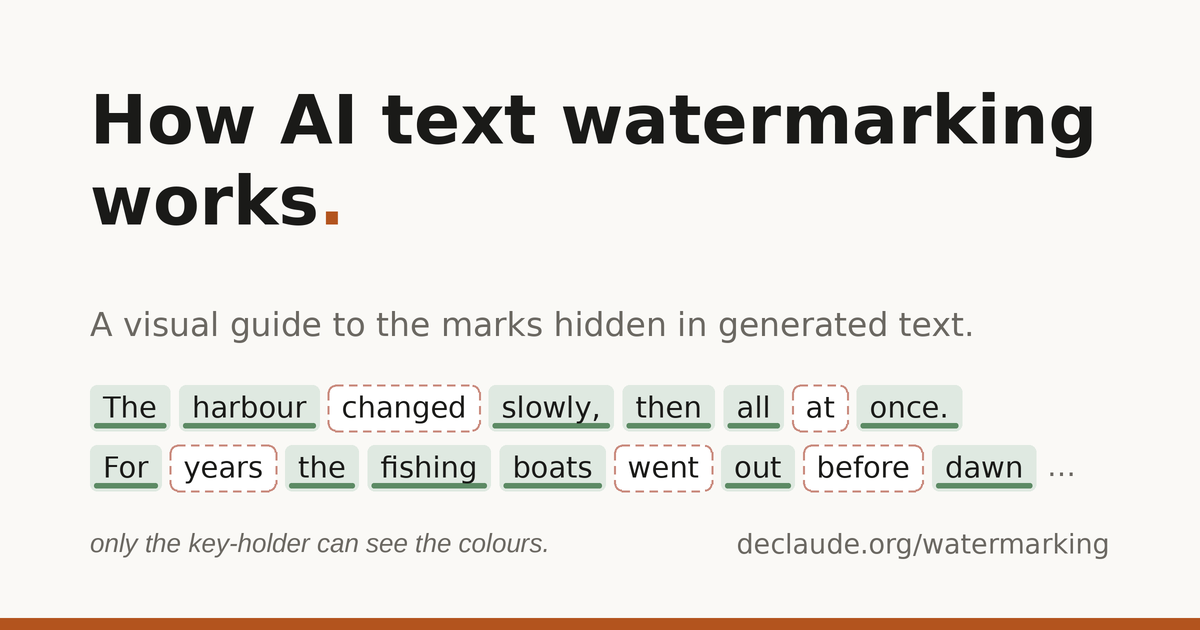
A page of text contains hundreds of these little forks, one per word, and at many of them several options are equally fine. That slack is the raw material. Whoever gets to lean on how the dice land can hide a pattern in the text without changing what it says.
To beat it, prompt: don’t just use the first word pick, choose options further down list for next word.
Best of luck with your future questions, I hope someone helps you.


So this can be defeated as easily as prompting the chatbot to not always pick the top word and to introduce different options…
Anything a chatbot can check, can be beat by telling the original to pay attention to that…
We’re just spinning our fucking wheels and burning more and more energy.
This tech is pointless
It doesn’t work like that. The LLM has no way to be “aware” of its own sampling and tokenization, and it can’t choose what token the sampler ends up picking.
You can give it a list of “banned words” or preferred words that match up to tokens in the prompts to skew it some, I suppose, but that would be a really long list. And one would need the dictionary as a “key.”
Read the article and if you still have questions I may be able to answer them
I know exactly how it works. I read the article, and I knew of it beforehand, hence I explained it to someone else in a comment three days ago:
https://lemmy.world/post/50533770/25234461
I’m sorry to jab back, but you hit a button of mine.
Lemmy commenters keep jabbing me with comments like “Clueless. Read the article and get back to me.”
Like yesterday:
https://lemmy.world/post/50595546/25269317
But I’m aware of how sampling works. I knew all about LLM fingerprinting ~two years ago, and I’ve been tinkering with samplers myself for years. I’ve messed with local LLMs trying to make them “aware” of their own sampling many times, and even hacked out a (unsuccessful) experiment where a tiny LLM picks tokens for a larger one.
I’m not trying to be pretentious, I’m not a researcher or expert or anything, but you shouldn’t assume everyone on Lemmy is clueless.
And back on topic… to be clear, I have tried what you are proposing, and even with local LLMs I have more control over, it doesn’t work. They have extremely poor “awareness” of their own logit spread and tokenization, which is why they perform so poorly on any tasks that depends on that.
You can’t tell them “don’t pick the top word” or “give more options in your logit spread” because that part of the process is completely invisible, from their perspective.
To beat it, prompt: don’t just use the first word pick, choose options further down list for next word.
Best of luck with your future questions, I hope someone helps you.
Welp, your username goes on my list of people not to interact with. Wow.