
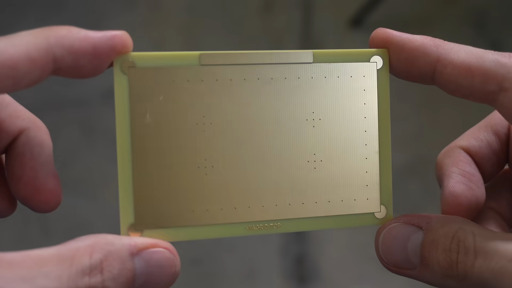
Breadboards are great, but as the world moves more and more to having SMD as a standard, prototyping straight PCBs is becoming more common. If you’re mailing off to China for your PCBs, it’s shockingly quick for what it is, but a one-week turnaround is not “rapid prototyping”. [Stephen Hawes] has been on a quest on his YouTube channel for the ideal rapid-prototyping PCB solution, and he thinks he’s finally got it.
Now, if you’re only doing single-layer PCBs, this is a solved problem. You can mechanically mill, or laser cut, or chemically etch your way to PCB perfection, far faster than the Chinese fabs can get you a part. If you want a double-sided board, however, vias are both a pain in the keister to do yourself, and a rate-limiting step.
Um, no. That’s just plain incorrect. 🙄
Plenty of useful circuits that are beyond “chuck together a couple of modules” or a “proof of concept” can be implemented on single-sided boards. Look in any hobbyist electronics magazine and you’ll find many of the project designs still use single-sided boards. Many products on the market use single-sided PCBs. My Hakko soldering iron’s control board is single sided. Every PCB in my Sony amplifier is single-sided. The SMPS in almost every LCD monitor, TV and more, exists on a single-sided board.
I would like to see you try to tell the Sony engineers who designed my amplifier that they weren’t “actually designing electronics”, or to the Hakko engineers who designed my soldering iron.
Tell the engineers at Delta that every single switch-mode power supply they ever designed on a single-sided board doesn’t count as “actually designing electronics”.