

They stressed the need to improve the representation of underrepresented regions such as Africa and Latin America.
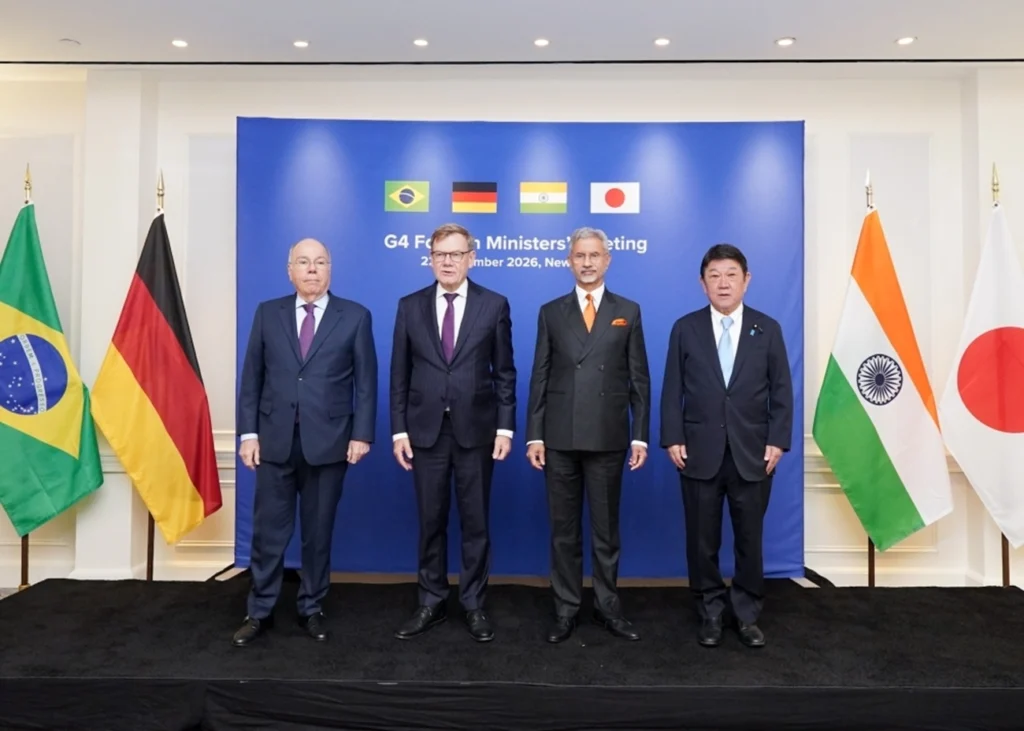
On Wednesday, the foreign ministers of Germany, Brazil, India, and Japan (the G4 group) met in New York on the sidelines of the UN General Assembly to push for reform of the Security Council.
RELATED:
Cuba Rejects Trump’s Statements at the UN General Assembly
In a joint statement, they warned that the Council “is not in a position to fulfill its core task” of effectively maintaining international peace and security. The G4 believes that this structure limits the Council’s representativeness, legitimacy, credibility, and capacity to act in the face of contemporary challenges.
They pointed out that the current composition of the body, with five permanent members with veto power and ten non-permanent members, is an anachronistic, eight-decade-old structure that does not reflect current geopolitical realities.
As a solution, they reiterated that it is essential to expand both the number of permanent and non-permanent members, a position supported by the majority of member states.
Joined my G4 counterparts from Brazil, Germany and Japan in New York #UNGA81
Discussed the imperative of reformed multilateralism and a more representative, responsive and effective UN Security Council that reflects today’s global realities.
Will continue to work together to… pic.twitter.com/IjuNBR1zLd
— Dr. S. Jaishankar (@DrSJaishankar) September 23, 2026
They stressed the need to improve the representation of underrepresented regions such as Africa, Asia-Pacific, and Latin America and the Caribbean, as well as of countries that contribute significantly to international peace and security.
The UN also welcomed the reform proposal presented this year by the African group at the Intergovernmental Negotiations (IGN), although it lamented the lack of concrete results after 18 years of discussions.
The ministers stated that they will continue to explore cooperation to develop a consolidated model that reflects the majority of member states. The goal is to begin negotiations on a foundational text that will allow for an effective reform of the Security Council.
#FromTheSouth News Bits | An economic recession in the United States affects major multinational companies; analysts note that these significant losses appear to be linked to President Donald Trump’s economic and immigration policies. pic.twitter.com/FNRuYE5Bpt
— teleSUR English (@telesurenglish) September 23, 2026
teleSUR: JP
Source: EFE
From teleSUR English via This RSS Feed.